Westover Cottage, Westover, Langport

The last time I wrote that address was around 1965. I was writing to my dad, telling him how my stepfather, Doug Donaldson, and my mum, had bought a derelict building. I remember the first time we walked inside. Looking up through two floors of empty space, at sunlight dotting through ancient roof tiles.
Some first-floor timber still remained, and the beams were solid – good bones. Over time, we’d be climbing all over that roof, scraping moss an inch thick off each tile and re-seating them. I don’t recall feeling hard done by — we were doing what had to be done and getting recognized as an important part of the team.
The skills we learned back then were pure gold, and the sheer history we were digging into; it was a real honour. Hand-made nails, wattle and daub, horsehair plaster — my own kids never got to see those. What they did see was me renovating with a mindset I learned down on the Levels: start the journey regardless of outcome. Just because you can’t see the summit, doesn’t mean you shouldn’t climb the hill.
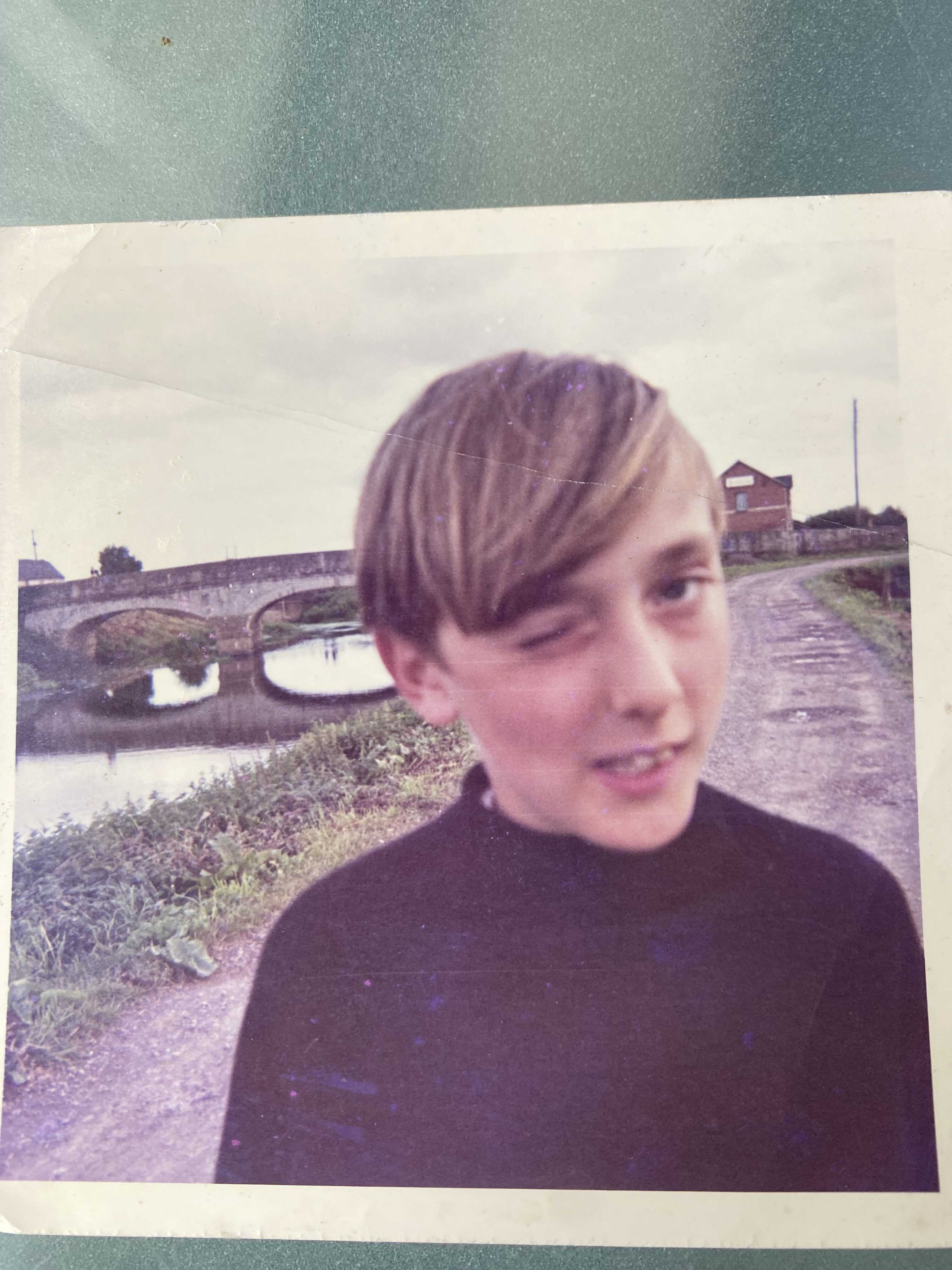
Coming from Surrey at age eleven, Somerset felt like a different planet. I’d grown up on top of a chalk ridge called Box Hill, with views stretching for miles — you could see weather coming for hours before it arrived. It wouldn’t be far off to describe arriving in Langport as though ‘shot from a cannon’.
It all started shortly before my eleventh birthday, Mum woke me around 6am which she had never done. She was saying things like ‘holiday’ and ‘surprise’. I got dressed and followed her through the kitchen to the back door, where I walked past Dad, who looked like he was trying to hide tears.
A strange car was in the driveway, and the driver was a man I vaguely knew. His son, Mark, was a boy I already knew, was sitting in the back seat next to me. Then mum climbed in the front and we drove away to Somerset. Before we pulled away I reached out the car window and snapped off a piece of the hedge. I kept it for ages.
It later became clear that my parents had what today might be described as an open relationship. Mum was up to marriage number 5 when she hung up her, well, whatever it was she hung up.
I’m guessing that on this occasion, things with “Uncle Doug” had become quite serious. I think the original plan was to return home at some point. After about three weeks, Mum rang Dad to say we were heading back. Unfortunately, a lady called Doris answered the home phone…Doris – there’s always a Doris – had moved in, and that was that. We never went home again. So I didn’t get a chance to say goodbye to Coco, our black Labrador, or my school friends.
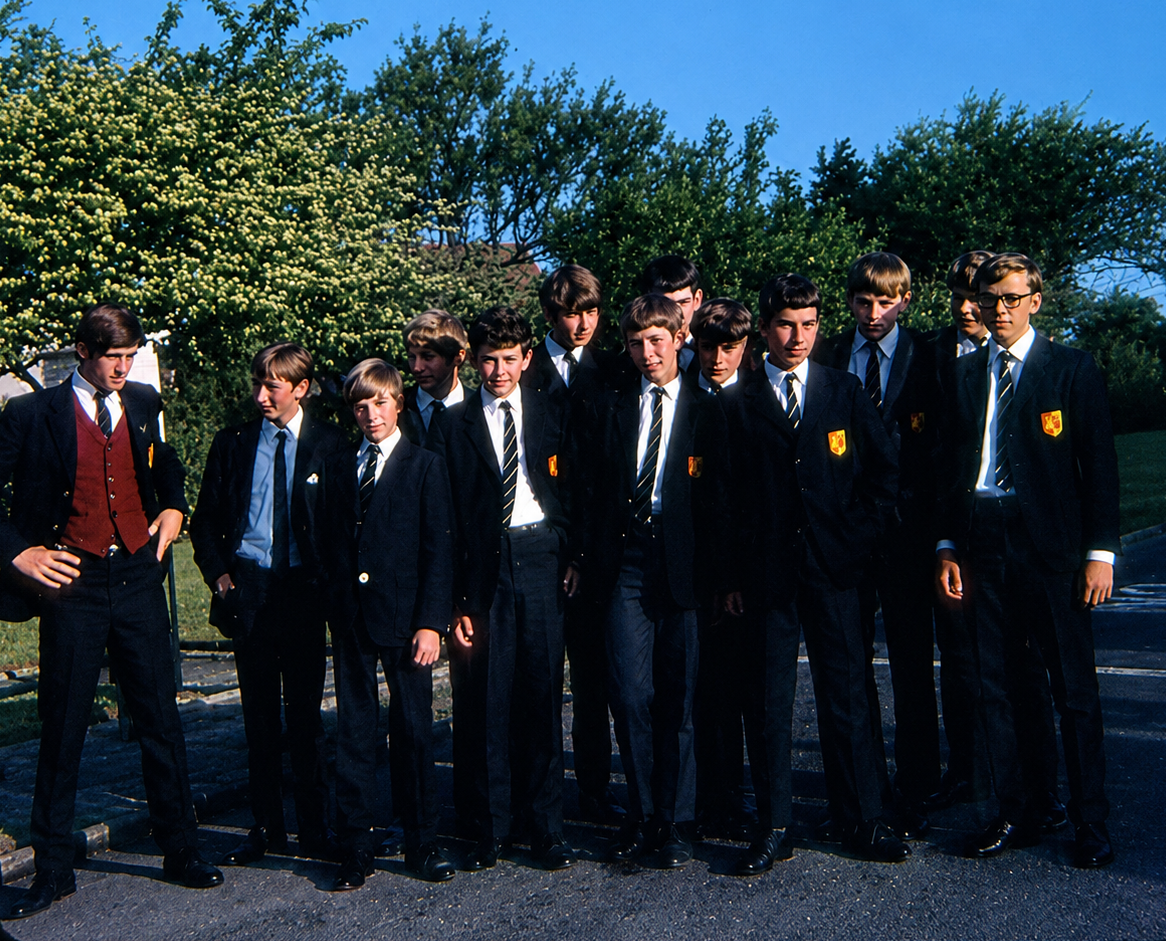
I sat the 11-plus, by myself, in a room somewhere in Langport, and found myself placed in C, of the A,B,C and D streams at Huish Episcopi Secondary Modern.
In the 1960s, the 11-plus was a high-stakes, nationwide exam taken by schoolchildren in their final year of primary school. Its results determined whether a student would attend an academically focused grammar school or be routed to a secondary modern school under the ‘Tripartite System’.
It took until the third form before I was top of the class in the annual internal test. Which put me in the B class, not long before the streams merged in the fifth year. The common room was very cool.
While I think fondly of Somerset, the early days were difficult to be honest. I was beaten up more than once in the playground, and quickly learned that, in that jungle, you were either a master or a slave, or better still, one of the great unnoticed. If you lost a fight, you were pressured to admit you were the latter. My first fight happened because I didn’t know what a Massey Ferguson tractor was! Random.
Having said all that, I wouldn’t change much, and feel that I received a special start in life that helped me hugely. Actually, I wish I had brushed up on my tractor names before moving to Somerset. Apart from the playground bullying, there were some wonderful moments too. In winter, the kids would create long ice slides, often stretching many metres, conveniently ending at a brick wall to bring you to a stop. There always seemed to be many rows of them.
My PE teacher never quite knew what to do with me. I excelled at cross-country running but was hopeless at team sports. One occasion I do remember involved the rope climb. We had to haul ourselves up a thick rope to the gym roof while he steadied it from below. After I climbed down, he looked at me, shook his head rather wearily, and said, “Go and put some underpants on, Payne.”
I learnt how to be invisible. Then I figured out how to fit in. I was that loud thin kid at the back shouting “FIGHT FIGHT”, and having the best time. Adapting and adopting local accents is another skill us British pick up fast. It came in handy years later when I found myself in New Zealand — but that’s another story. I learnt that attitude was 9/10ths of valour.
A few years later, those playground lessons actually helped stop me from getting stabbed in Athens. A mad looking drunk young Greek guy singled me out in a dimly lit alley next to a nightclub. As he fronted up, I made a split-second decision to perform a bit of amateur dramatic Shakespeare – something from Huish. This was as Bottom in ‘A Midsummer Night’s Dream’. My performance totally disarmed him, and we left the alley best mates, laughing about it all.
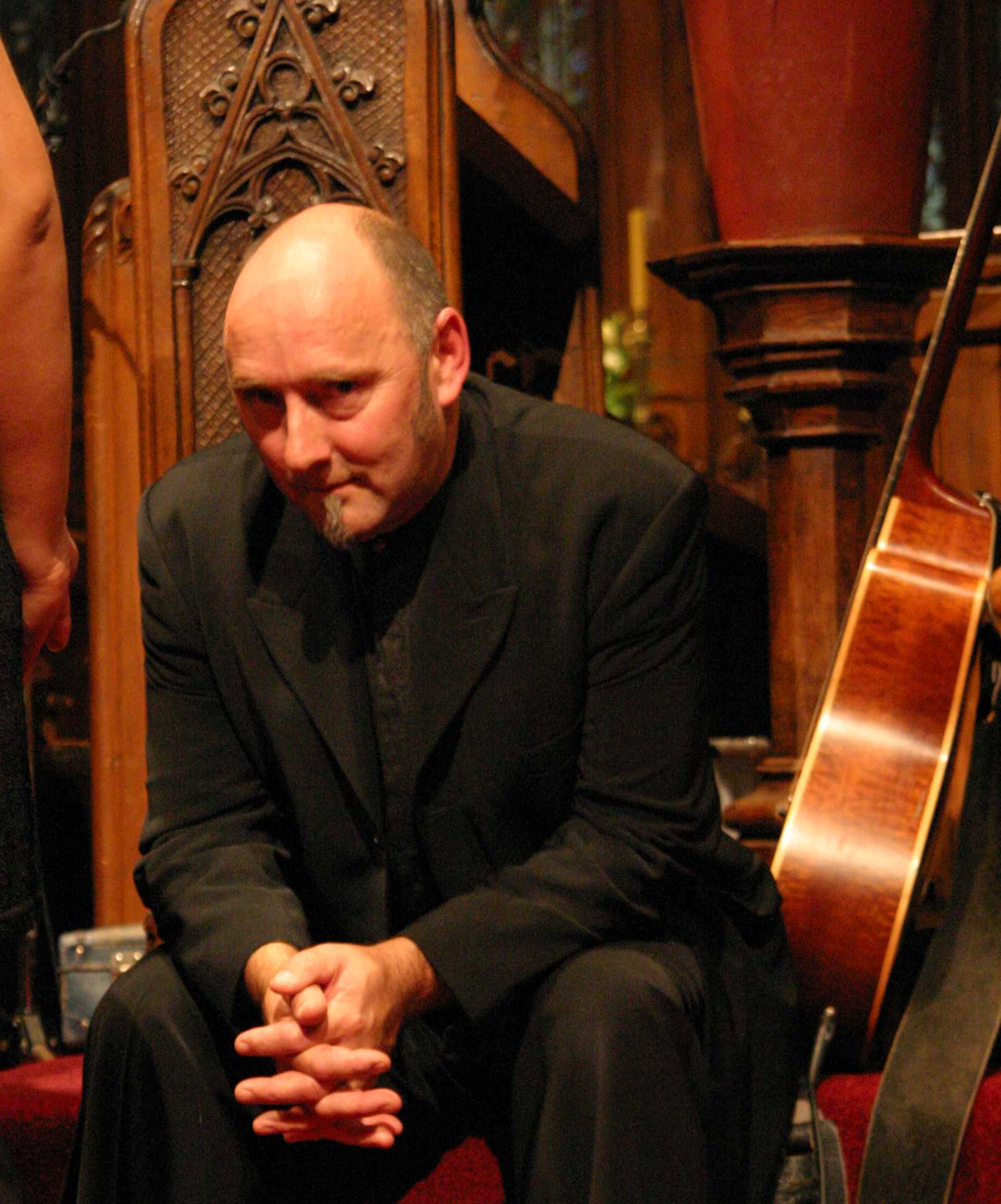
My beloved music teacher at Huish, Mr Gray, said it was a great singing part for me. He went as far as try to interest me in training in Opera. Affectionately called Fungi after a dismal attempt at growing a beard, he coached many of us in confidence to perform. Thanks to Fungi, I have music on all reputable streaming platforms (shameless plug).
Music and art – when words and numbers elude, there’s always the arts. A new young art teacher Mr Barry Jones arrived and spotted that I was keen on art and not sport. He arranged for me to miss sport and instead set me up to practice art in a big storeroom next to the classroom. Thanks to him, and a spell at the Somerset College of Art and Design in Taunton, I had a successful Graphic Design business for many years, then taught visual communication.
Meanwhile, back down on the Levels in 1966, morning mist over the moors gave the feeling of floating above cloud. It was magical. Unsettling but benign. The fields, criss-crossing with ditches, gave the whole place an Arthurian ‘Lady of the Lake’ kind of vibe.
Somebody should start writing Somerset Noir detective novels – there really was pub called the Black Smock (in Stathe), now a private residence, but also formerly known as The George. There’s a book title in ‘The Hanging Chapel and the Bloody Assizes’. We don’t really have gargoyles in Langport sadly. Ours are called ‘hunky punks’, Unlike standard gargoyles, these decorative, mythical figures were crafted by medieval masons to fiercely protect the church from evil rather than to drain rainwater. Strange but true, there’s also ‘Hinky punks’ — the actual old name for will-o’-the-wisp marsh lights said to haunt the Levels and lure travellers off the causeways. Lastly, it doesn’t get any more noir than the last battle fought on British soil – the Battle of Sedgemoor (1685) at Westonzoyland,
Talking of churches, I was forced by a dare to scale the walls of the convent at night, and swim naked in the pool. St Gildas Convent was where I first met my best mate, Peter Cleary. The convent (that place, with around 200 girls behind a brick wall), hosted a fundraising village fete every now and then. How I ended up in a tiny tent with a sign outside saying “Come in and meet the Holy Friar” is anyone’s guess. Peter paid the threepenny admission and was greeted by me, dressed in a hessian sack, standing beside a single candle on a table, with a battered frying pan suspended over the flame. Apparently it made quite an impression!
I did grow to love local traditions, like “ditch jumping” — racing each other across fields, making split-second decisions, leaping, and more often than not landing in the water instead of on the far bank. Scrambling up, soaked, and off again.
One winter, the fields by the river around Langport flooded, then froze. Miles of ice a few inches thick – enough to skate on. A one-off, amazing thing to experience. Weaving around tufts of grass – if you had skates.
As newcomers to the river, we knew nothing of the area’s history, let alone the cottage we lived in. We couldn’t have imagined lines of barges plying the Parrett. Dozens of carts laden with goods, stretching from the river to the bottom of Langport Hill. There’s a large storage building in front of our place that in 1840 was owned by Vincent Stuckey, possibly for the firm of Stuckey & Bagehot. They were the big movers back in the barge days.
Westover Cottage was eventually renamed Damery House by my mother, after a street in Blandford Dorset that she was born on. Rumour had it that the site had once been a nunnery, and that, being on the far side of the river to the town, had housed a leper colony. That the cottage had been built over older ruins wasn’t hard to believe — the lower walls were noticeably thicker in places, built from larger stones. When we cleared ivy from an outer chimney wall, we found a tiny window hidden behind it. Locals nodded sagely: “Oh arrh, there be a monk’s passage there be”. Renovating took a long time. My stepfather worked a milk round from early morning, then came home around lunchtime to join us, working into the evening.
My family lineage was post war working-class, moving out of London after the war and finally doing okay. They moved to Box Hill, Surrey around 1949, and started out in a caravan on one of the many caravan sites on Box Hill. Wonderful names like Roof of the World’ .
There was a family dog that brought home rabbits. My mum apparently skinned them, and made things like waist coats, hats and mittens out of the skins. My poor elder brother and sister had to wear them – and they were known as the ‘rabbit children’ on the school bus. Luckily, I was still 10 years away from being born. The lucky youngest they called ‘Prince Philip – he who could do no wrong’. Dad did okay with what he had and started his own window-cleaning business, which I was destined to take over. But happily, fate had other plans.
In Somerset, the first three years were pretty hand-to-mouth. I remember absorbing some of that worry, riding my bike around town looking for dropped coins. Never found any, but I felt like I was contributing.
Out the back of Damery, Mum laid a lawn by hand, carrying sods of roadside grass, until she’d pieced together a patchwork of green. It looked fine in the end, and the hand mower couldn’t tell the difference. The garden backed onto what had once been the bowling alley of the Old Railway Hotel. The pub gardens must have extended into ours, as every spade of soil brought up shards of churchwarden pipes. The best finds being embellished pipe bowls.
Our favourite walk was along the arrow straight disused rail track, all the way to Burrow Bridge. Growing both sides of the track, but not yet invasive, were masses of blackberry bushes. I can still smell them.
Also out the back was a thoroughly entertaining pig farmer. His party trick was shouldering large sows that refused to move. The squealing was tremendous!
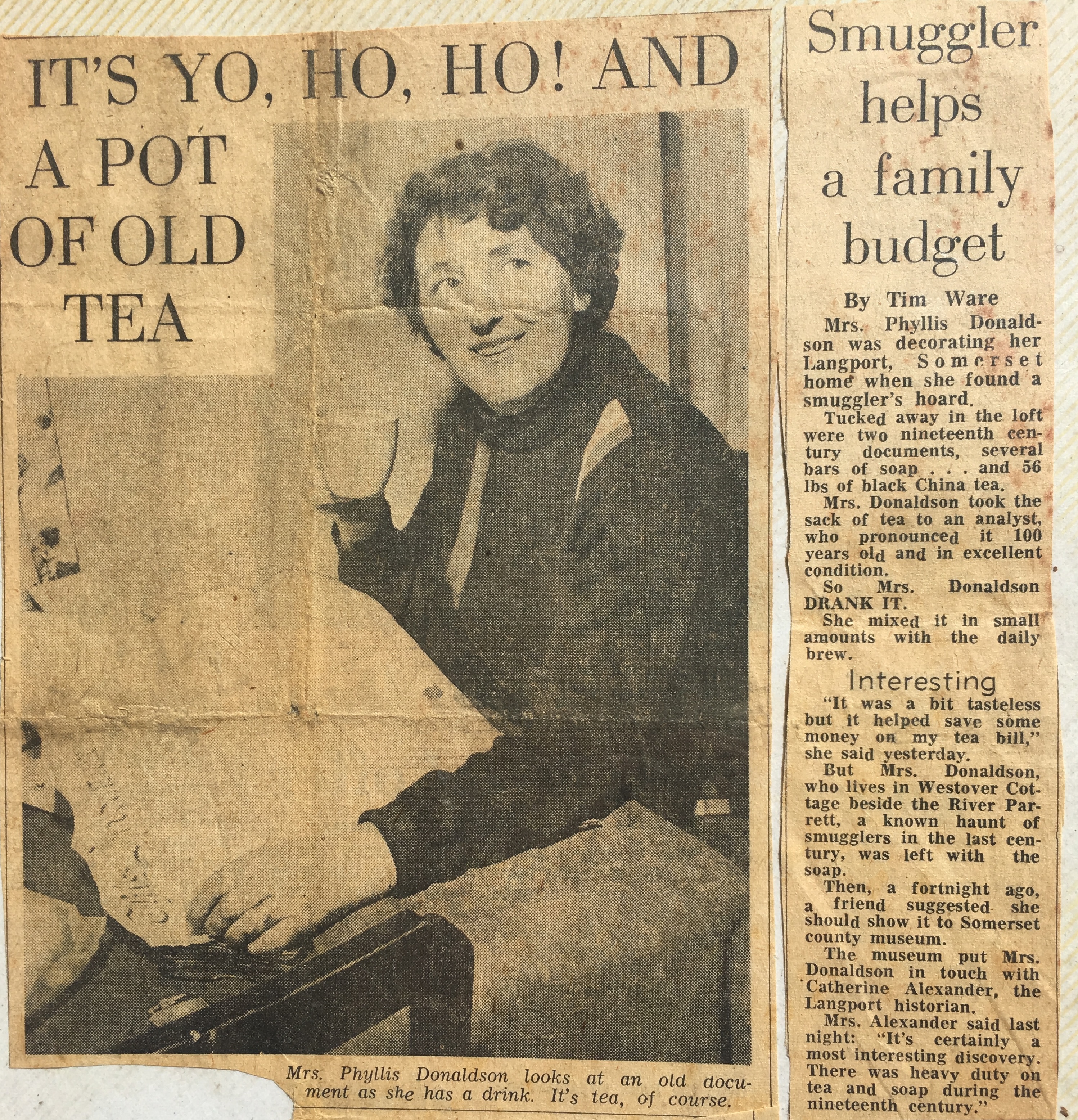
My brother Mark and I enjoyed demolition — plastered walls and ceilings had to come down. Which is how we found our “smuggler’s hoard.” We were hacking away with claw hammers at the thin wooden slats beneath the ceiling plaster, when a large hessian sack dropped out of the cavity above. It was black with age and fell apart on impact. Inside was a treasure! Well, it looked like it to us.
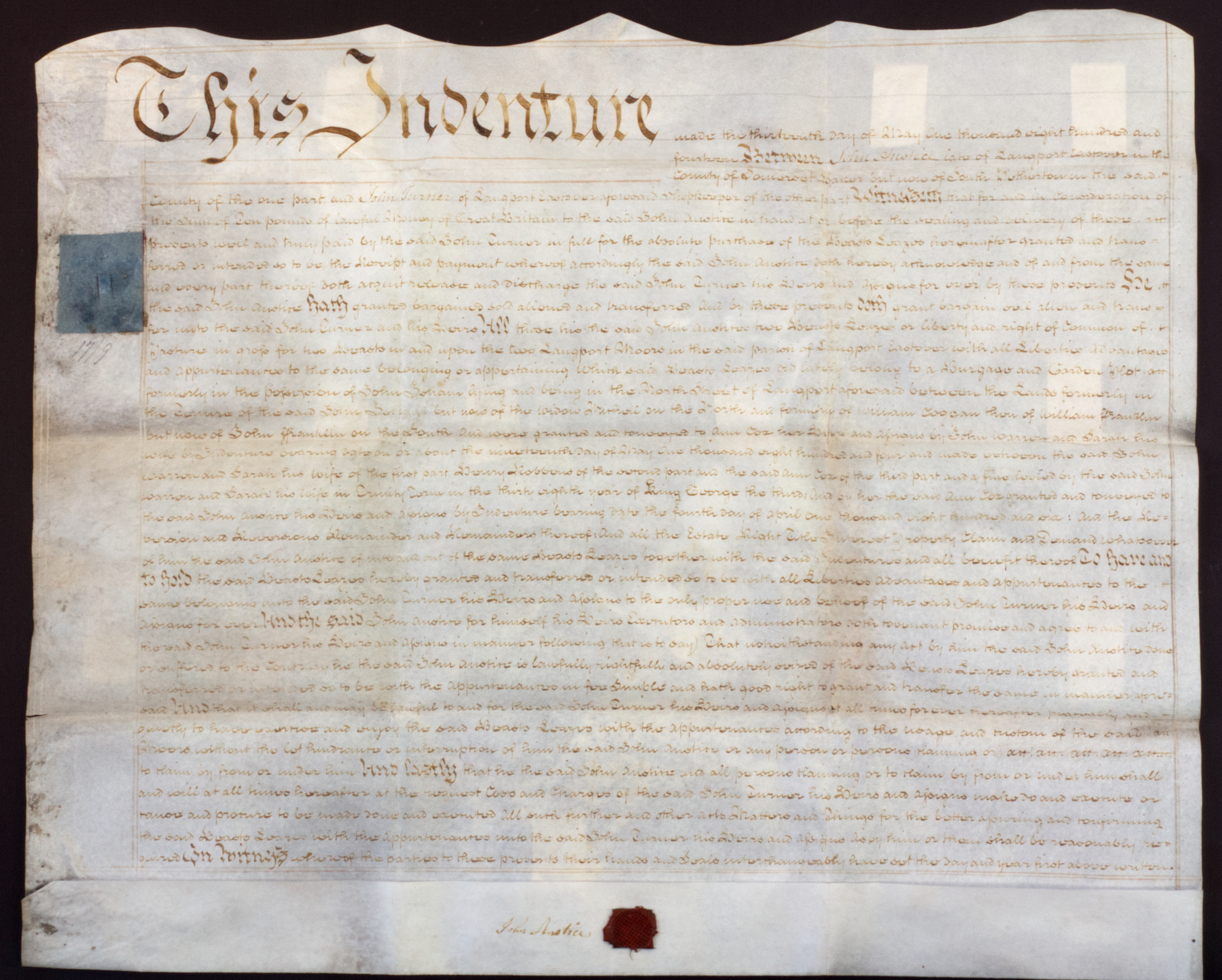
Inside, we first found two handwritten legal documents — called indentures. Opened out flat, they were covered in fine handwriting, the ink the colour of dried blood. Ok, tan coloured then. Oddly, the top edge was cut in a wavy line, with the bottom folded over and sealed with wax. We later learned this was how old legal documents worked: written twice on a single large sheet, then cut apart along a unique wavy line so the two halves could later be matched to prove they were genuine. The fold and seal meant nothing could be added afterwards. Genius, really.
The indentures were dated, which gave us a sense of how long the sack had been hidden in that ceiling:
“Made the thirteenth day of May, one thousand eight hundred and fourteen, John Justice, late of Langport Eastover in the County of Somerset, Baker, but now of South Petherton in the said County…”
Two coins – Crowns, were from the reign of George III and also helped confirm the date.
Inside the sack was a second, better-preserved hessian bag – full of tea. We sent a sample to a tea company, who were quite excited and told us it was a blend called ‘China Black.’ They were rather disappointed to learn that, by the time they got back to us, wanting a bigger sample to verify the exact blend used back in those days, we’d already drunk it all.
Lastly, there were two long bars of handmade soap. Strangely, I’ve carried one of those bars around the world with me. It now lives in my sock drawer — no idea why. It’s dried out somewhat but still smells faintly of tallow. I had hoped a soap company might want a sample, but none of the places I’ve contacted over the years have shown any interest. Isn’t there a saying about a bar of soap? I can happily report that the indenture is now safely framed under conservation glass. As I understand it, the smugglers’ hoard story made the local paper and was later picked up by the Daily Mirror — our second of fame.
Renovations continued. The back part of the building was a separate barn, with its own outer door and no internal access. With the help of Janet Seaton, Chair of the local History Society, we discovered that Westover Cottage had originally been a malt house owned by John Turner the Younger. That made sense — owners often lived right beside these specialized buildings, where malt was processed for brewing, and timing was everything.
Once the house was habitable, and had enough bedrooms we ran it as a B&B. It was busy from the outset, and we had quite a few fishermen stay. They travelled from all over the UK to go coarse fishing — apparently the River Parrett was pretty famous in those circles. With Doug’s help, my brother and I built our own bedrooms with dormer windows in the V shaped attic, as all the bedrooms were being used.
As the business grew, we bought an old clinker-built wooden rowing boat. It needed work, and I can still smell the pitch — a kind of tar — we used to seal the joints. The brass rollocks (I loved those, mostly for the name) cost more than the boat itself. Turns out they’re spelled “rowlocks,” not “rollocks” — boring, but there it is.
My official job was rowing guests upstream to fishing spots. Nobody seemed to want to fish downstream towards the railway bridge. Unsure why. However, my self-appointed job was finding the source of the River Parrett. I probably should have just looked it up on a map first, but like Shackleton, I followed my heart.
Every summer I’d set out with a cut lunch and no real plan, each trip getting a little further upstream than the last. My dream of being first to find the source was dashed at a millpond — the boat was too heavy to drag around. I slept in the boat overnight, under the stars. Every so often there was an almighty splash, as if someone had thrown in a large boulder. Nothing to see but ripples in the moonlight. Locals later spoke in whispers of “the millpond bomber” — a legendary pike, supposedly the size of a man’s leg. It had been hooked plenty of times but never landed. Fishermen swapped stories of catches that came up bitten clean in half.
Guests were not always fishermen. There was a time we called ‘the year of the gas men.’ For months, crowds of gas fitters stayed at our B&B as part of a nationwide changeover, often called “the Great Switch,” which rolled out region by region between 1967 and 1977. The UK was moving from coal-derived “town gas” to natural gas from the North Sea, and because the new gas burned differently, something like 40 million domestic appliances — stoves included — had to be modified or replaced. I loved it, because my rowing duties were cancelled for a while, leaving more time for puberty. I navigated that tricky transition with whatever Langport had to offer — at the time, that meant the choir at Huish church, or the Langport youth club. I’ll leave it there.
Around fourteen, I went to Russia. Mum was thrilled, she being a card carrying Communist at the time.
In the early-to-mid 1960s, the British India Company ran two post-war ships, converted to floating classrooms, cruising the Baltic, before a third joined later. The MS Dunera, converted in 1961 and the pioneer of the route, famous for carrying thousands of children to Leningrad; and the MS Devonia, which joined in 1962. Since both shared the same route and the same onboard classrooms, plenty of British students of that era sailed on one or the other.
Life on board was amazing — sadly, not a rollock in sight. It took days just to stop getting lost in the maze of corridors. The route took in the island of Visby, Denmark, Sweden, and finally Leningrad — but the best part to me was the overnight train. With no sleep till Moscow, we watched from our bunks in the old school, wood-lined sleeping compartments, as the rural Russian landscape rolled by, turned a strange colour under the midnight sun — a perpetual sunset, perfect for sightseeing. Moscow itself was quite beautiful. In spring, its usual grey is transformed by drifts of pink blossoms. The Underground stations looked like museums — statues, art, no graffiti anywhere.
A boy in our group got into serious trouble. He was caught shoplifting in GUM, a huge department store facing Red Square, aimed at tourists. I can’t imagine what possessed him, given how closely we were watched by our guides. More than once, a local would sidle up and quietly ask if I had any US dollars to sell. All in all, an extraordinary experience. He escaped with a telling off.
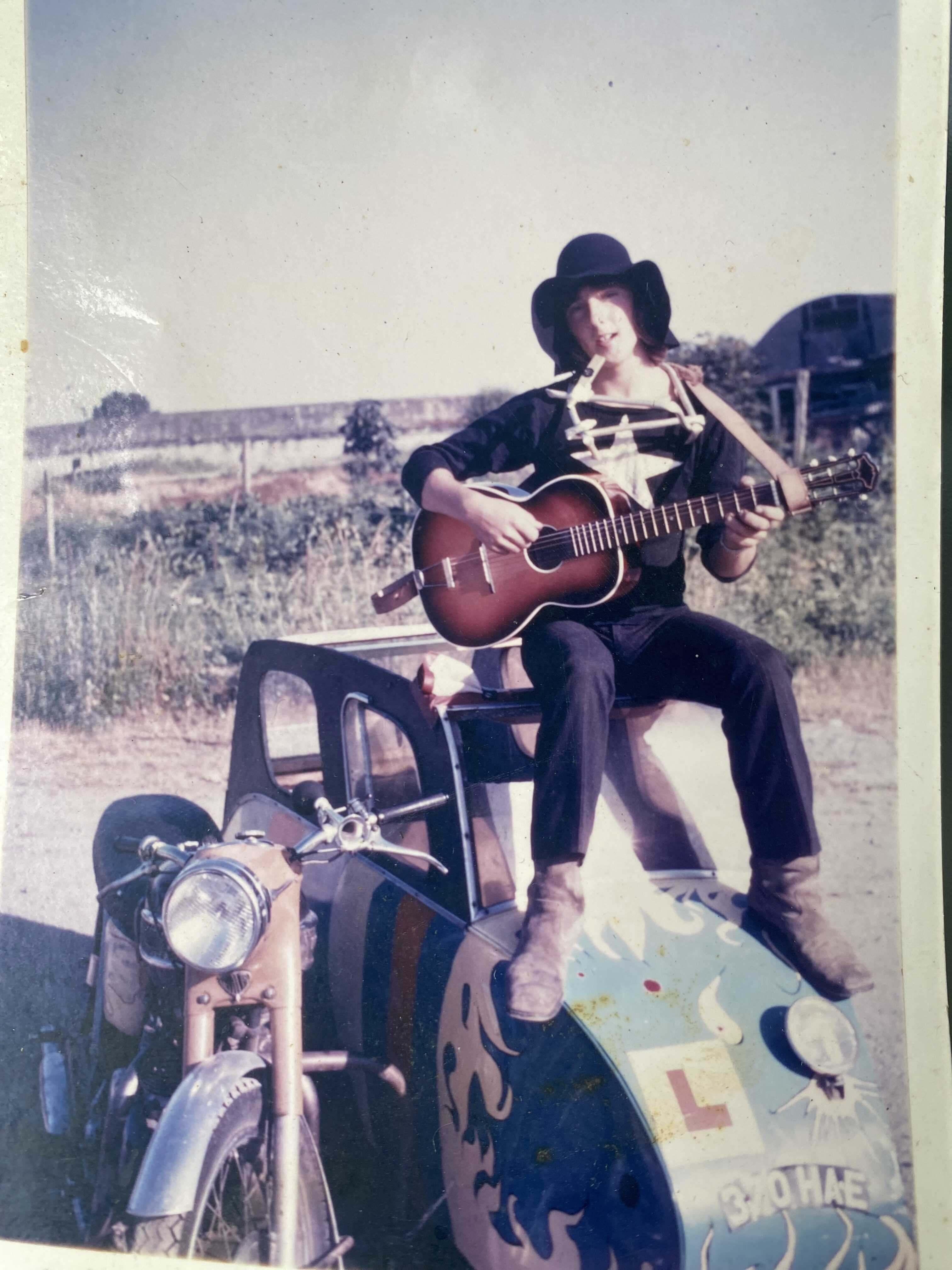
At fifteen, I took up the guitar, absorbing folk, Niel Young, Bert Janch and Stephan Grossman. But I felt I needed something more — and the answer lay in the oddities of the road rules at the time.
On a learner’s licence from age 16 (basically an L-plate and no test) one could legally ride any size motorbike with a sidecar, as it was technically a three-wheeled vehicle. An advert for a motorbike and sidecar in Bristol — a Triumph Thunderbird 650cc — caught my eye. Having never ridden so much as a moped, I travelled by train to Bristol and drove it home – in the middle of winter. I have never been as cold, before or since. By the time I pulled up outside the house, I genuinely couldn’t get my hands off the handlebars — lucky there was a horn button, which I leaned on until my parents came out to peel me off the bike.
On the very first corner of that ride, I went straight across the road — unlike a pushbike, this three-wheeled beast didn’t lean into turns, and I hadn’t reckoned on how heavy it was. Pure luck that nothing was coming the other way. By the time I reached Langport, though, I was flying under the railway bridge corner like a pro.
I had paid for it with odd jobs, including haymaking, where lunch in the field meant a pint of “Natch” (the local cloudy, still cider), a great chunk of white loaf, a generous hunk of cheddar, and pickled onions — the ploughman’s lunch. Out in the field on a hot day, scrumpy didn’t actually get you drunk. Instead, it gave you the energy to get through the afternoon. By contrast, in the pub — a cloudy and faintly green pint from the wooden barrel in the tap room took the feeling out of your legs entirely. I was told, though never witnessed, that a dead rat was put in each barrel, and once it had fully dissolved, the brew was ready. You knew you’d earned some standing in the pub once you were allowed more than one pint.
My theory was that wheels would make me irresistible to the opposite sex — even fifth formers. The reality was that these wonderful, unreachable beings called older girls did appreciate wheels, just not my particular three. Mostly, I attracted the attention of the police. Still, things were looking up — I’d been accepted as an art student. I pulled the two seats out of the sidecar and replaced them with a mattress. I was officially a babe magnet.
A summer touring Cornwall with two mates was pretty memorable. St Ives, mecca to hippies, was great but crowded. We got an education into local K9 police’s approach to clearing rough sleepers, dogs included. One trick of ours was to dash down to a strip of shoreline known as the queen’s chain, where the theory was you couldn’t be arrested.
The ride home marked the end of that particular vehicle’s career and was sold for scrap. I moved on to my next three-wheeler — a bubble car, with about as much luck on the romantic front. My mate, Peter Cleary, bought one as well. What’s better than a bubble car? Two bubble cars! Quite why this didn’t make us irresistible remains a mystery.
For me, art college in Taunton meant leaving Langport behind after a stay of 10 years or so. Doug developed cancer, and they left to run a caravan site on the Lizard, Cornwall. Yes, my parents left home and left me. What could possibly go wrong? The plowman’s lunch was mirrored in every Taunton pub: a pint of natch, a packet of salt and vinegar crisps, torn open and placed on the bar, with a pickled egg on top.
The house remained empty for some time and was eventually sold.
And that’s me — in the hippy ‘summers of love’ — riding off into the sunset, love life much improved, chasing the dream – on a Vespa Sportique. What?
Philip (Pip) Payne
Wellington
New Zealand
2026
Click on the image below to enlarge it and see the caption.