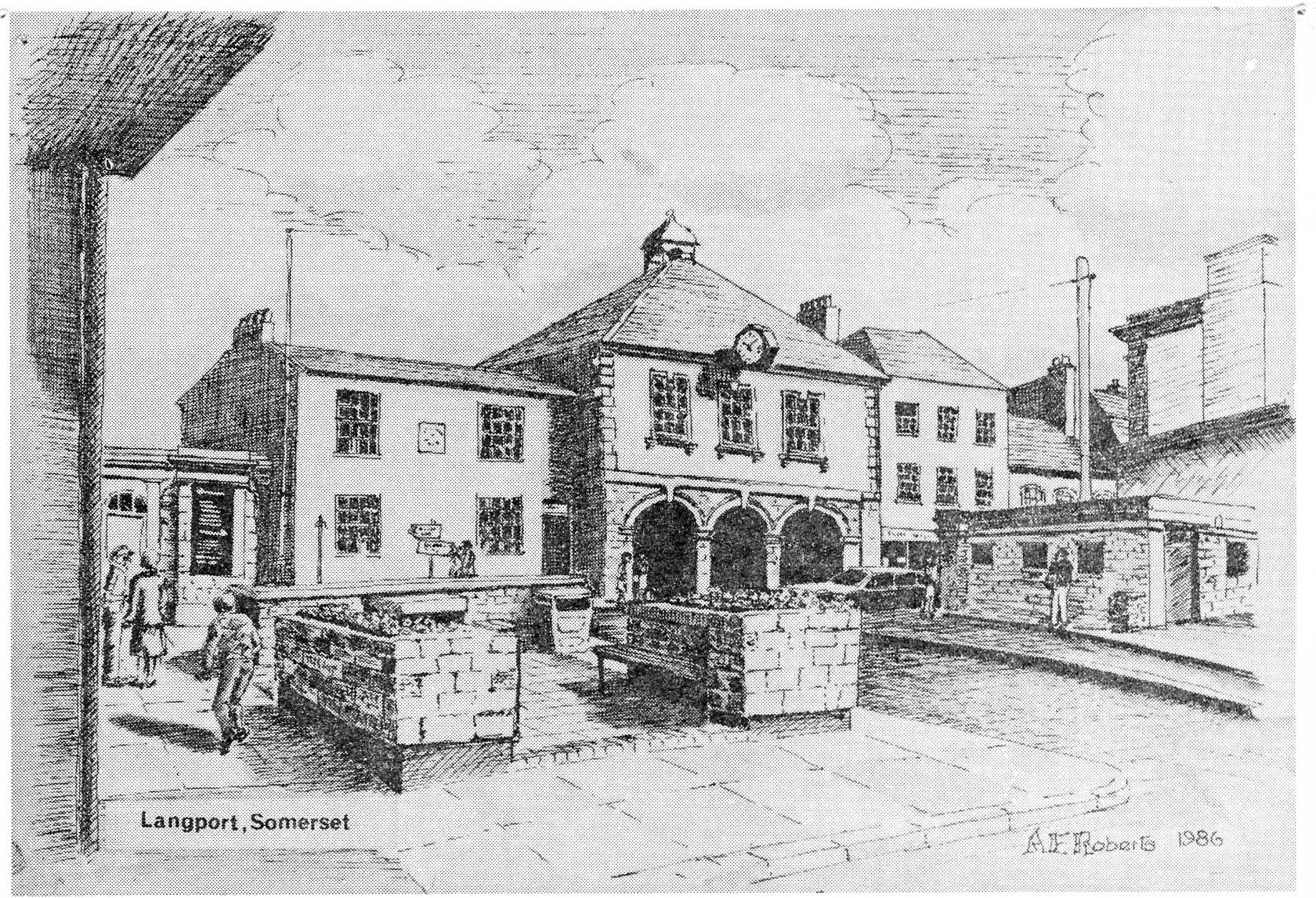
A Town Hall, often referred to in earlier times as the Guildhall, is recorded in Cheapside in 1596, although the Hanging Chapel was used as the town hall for some years afterwards. Their 1616 charter gave the Corporation the power to ‘have, retain, and erect a council house’, and this may have caused them to return to the hall in Cheapside. The Corporation silver-gilt mace, which is 14 inches long, is thought to date from 1625-1649.
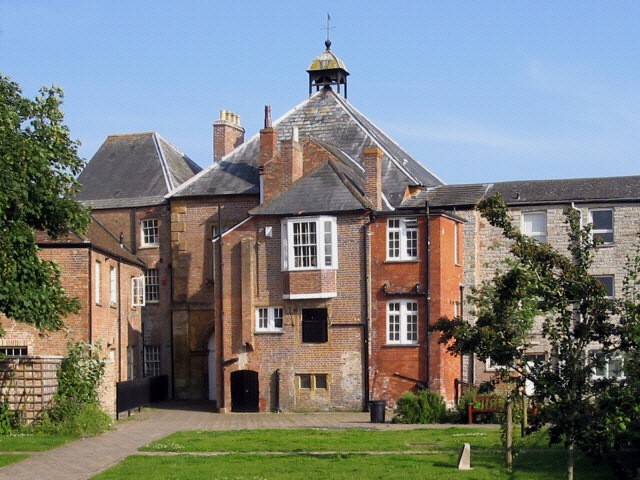
The present Town Hall was erected in 1732, and presumably completed in 1733, which is the date displayed in the weathervane on the top of the building. This makes it the oldest Town Hall in the West Country to be in continuous council use. Markets were held in the undercroft for many years, and the fire engine was stored there in 1925. Adjoining the original Town Hall building, but now part of it, was the Institute, built in 1833, which included a reading room and library, as well as rooms for playing cards, billiards and bagatelle. Both are Grade 2 listed buildings.
The Town Hall was formerly the home of a county court. The chamber pot pictured below is said to have belonged to the last judge to ‘sit’ at Langport, when the County Court was held in the Town Hall. It is white, decorated with a transfer design of blue Italianate landscapes and flowers. The words ‘County Court Langport’ are hand painted on the side and on the inside of the base. The mark on the bottom of the pot says ‘Palermo’ and ‘R & D’ within some type of royal coat of arms. The expert at Lawrence’s Auctioneers estimated that it was produced in about 1835.
The Town Hall has an unusual octagonal clock. Behind the building lies a garden, now called the Walter Bagehot Town Garden.
Click on an image to enlarge it and see the caption