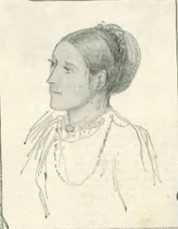
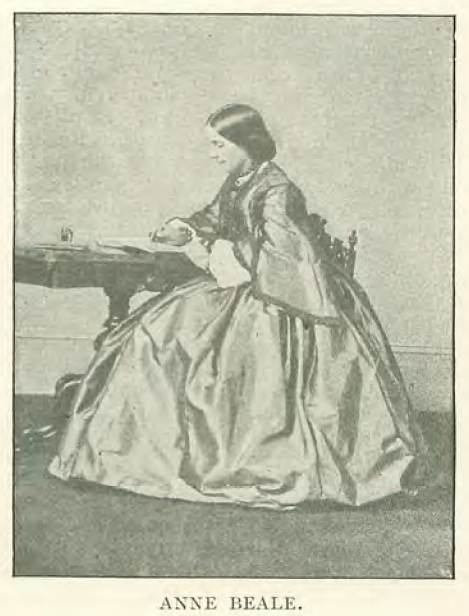
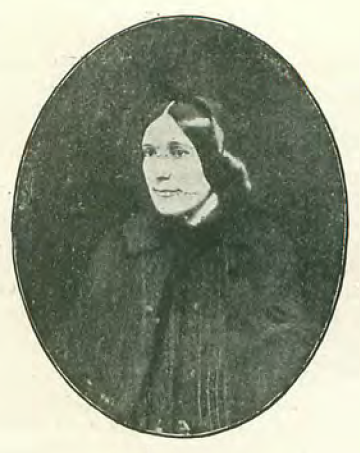
Anne Beale was born in Portfield, on the outskirts of Langport, in 1815. She was a novelist and poet who was well known in Victorian times, and her death in 1900 was noted in the national press. For example, The Times described her stories as “deservedly popular, and she was greatly beloved by those who enjoyed her personal friendship.” Like her first novel, The Vale of the Towey, many of her works were set in Wales. We know quite a bit about her life and career from her diaries, extensive extracts of which were published in The Girl’s Own Paper in 1901.
Her parents were Thomas Beale, a ‘gentleman farmer’ of Curry Rivel, and Elizabeth Gerard, who were married in 1809 in Ryme Intrinseca, Dorset, Elizabeth’s home parish. They settled at Portfield Farm, between Curry Rivel and Langport, not far from the Bagehot family home at Herds Hill. Their first child, Elizabeth Compton Beale – known as Bessey – was born in 1810, and Anne came along five years later. She was baptised at St Andrew’s Church, Curry Rivel on 14 October 1815, and was educated in Bath by a Madame de Bellecour.
Thomas died in March 1829. In his will, made in January of that year, he described himself as a gentleman of Langport, so the family had probably moved to what is now Eastdon House, on The Hill between the Hanging Chapel and All Saints’ Church.
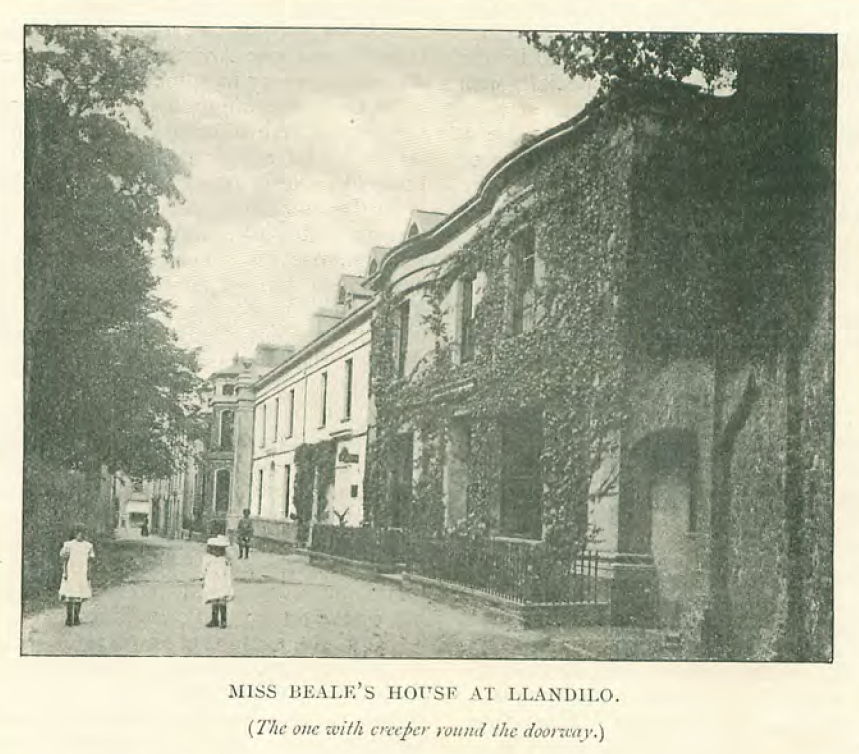
Her older sister, Bessey, apparently helped to support the family through professional singing, and by the late 1830s, Anne worked as a governess for a family near Hereford. By 1841 she had moved to Wales. According to that year’s census, she was a governess in Llwynhelig, Carmarthen, where her mother came to live with her in nearby Llandeilo.
She also tried to open a school for middle-class and upper-class girls, but when there was no demand, she dropped the class-based requirement, and her establishment became a success. A Welsh newspaper advert of January 1852 – when she was finishing her work as a governess – offered specialist teaching by an Anne Beale in French, Italian, German music and drawing (Welshman 23.1.1852)
Her connections with Wales were strong and her descriptions generally fondly received. For example, an 1869 review of her novel, Country Courtships, in the Welsh newspaper The Welshman reported: “She knows the country well, and her descriptions of its scenery, its institutions, its people are severely truthful but, at the same time, so skilfully done, and with so much warmth and character as to captivate every person who cares to read one of the best and ablest novels of the season.” Her entry in the Dictionary of Welsh Biography stated that “Several of her novels deal with the manners and customs of the Welsh people. Few English writers have written more appreciatively of Wales.”. However, her time there did not appear to be all sweetness and light, according to her diaries.
The Langport property was sold in 1847, when Anne’s diary notes that it went for £200 to a Captain Aldridge. The family finances seem to have been in dire straits because they only received just under £39, after paying off a mortgage and costs: “Please God we shall now be able to pay off our little bills and begin clear once more.”
Mrs Beale died in 1870 in Llandeilo, aged 89, and the two sisters moved to London, settling in South Hampstead, at 68 Belsize Road, where Bessey died in August 1895. Anne died there on 17 April 1900 and was buried in Camden. Her will was proved on May 14, the value of the estate being £1691 11s 2d, according to the Glasgow Herald of June 7.
Her legacy
There was wide, if limited, newspaper coverage of her death, with any obituaries generally positive about her writing career, though with a slightly patronising undercurrent focussing on her being a writer mainly for women and girls. Perhaps surprisingly, there did not seem to be much, if any, detailed recognition from the Welsh press, though North London papers noted her later life in Hampstead. Similarly, there was minimal coverage in Somerset, and the Langport Herald did not report her death until its May 5 issue. Even this was merely a report of the short notice in the Athenaeum paper of April 28, with the brief addition that she was “a native of Langport.”
Beale’s Langport and Somerset connections were not always ignored. At the August 1861 annual meeting of the Somerset Archaeological and Natural History Society (SANHS) at Langport, one keynote speaker, a WW Munckton, giving a paper on Langport’s history and heritage, listed its various claims to fame, including: “And last, not least. Miss Anne Beal, who has wielded her pen in polite literature so ably and successfully, was a native of this town.”
A merchant ship, built In Prince Edward Island, Canada in 1877 and registered at Swansea as owned by W H Tucker & Co, was called the Anne Beal (or, in some sources, Anne Beale). It was abandoned at sea off the Azores in October 1882. Given the contemporary Welsh provenance, it may well have a connection with the novelist.
Her diaries on Wales
The publication of her diaries in The Girl’s Own Paper in 1901 caused ripples in Wales. The Carmarthen Weekly Reporter of May 17 reported that “some of the revelations of that diary have created quite a sensation amongst the residents of Llandilo, who knew Miss Beale as a governess in their midst.” Describing a reference “in anything but flattering terms to one of our local aristocrats”, the author of the piece claimed that “I know of some of Miss Beale’s old associates, who so far have not been referred to, who are dreading to see future issues of the paper lest they too may find themselves notorious.” A little unhelpfully for historians and other researchers, the article’s view of this was clear: “The moral is ‘Don’t keep a diary’”.
A retrospective piece on her in the 9 September 1966 issue of the Welsh edition of the Liverpool Daily Post described her as “a perceptive writer on the Welsh and their ways.” A more considered view of her Welsh connection, taken from her diaries, appears on, of all things, a website on Welsh costume. It provides some useful insights into Beale and Wales, as the following extensive extract shows (https://welshhat.wordpress.com/introduction/the-nature-of-the-evidence/anne-beale/):
Beale kept a diary, 21 volumes of which she bequeathed to Charles Peters, her executor and editor of The Girl’s Own Paper, (for whom she wrote many articles). He published extracts from her diary in 21 parts in volume 22, (1900-1901).
The extracts focus on Anne Beale’s duties as a governess; her concerns about her mother (with whom she lived in Abbey Terrace, Llandeilo from at least 1841); their financial worries; her relationship with George Price to whom she had been engaged and with whom a friendship was renewed in 1846 ‘after 3 years of alienation’ and her concerns over the decline and death, in 1852, of Mr Pugh, vicar of Llandeilo. The diary also includes accounts of her social life in Llandeilo and her role as one of the worthies of the place (in giving small presents to the poor at Christmas time). She also wrote about her feelings of unworthiness.
It is surprising that the editor of The Girl’s Own Paper chose to publish some of this, especially her honest account of the somewhat bumpy relationship she had with her employees and their three daughters to whom she was a governess, one of whom might have prevented further extracts of her diary from being published. (The Carmarthen Weekly Reporter, 19th July 1907, p. 1)
The published extracts contain almost nothing about her Welsh working-class neighbours of whom she wrote so much in her novels but it is possible that the editor disregarded such comments. Both her diary and her published writings show that she had progressive ideas about the role of women in society, which she espoused as a single woman who was ultimately able to make a reasonable living from her writing.
The extracts make almost no reference to her work as a poet and writer. The last published entry for 1841 was on the 17th November ‘Finished the last proof-sheet of my book and sent the preface.’ This was presumably her Poems published in the following year. By the beginning of 1847 Beale seems to have completed Gwenthlean which she read to Mr and Mrs Gardener on the 13th February that year. This might have been The Baronet’s Family (1852) which features a character called Gwenthlean. Seven days later she wrote:
Have begun another book more for amusement than with and view to publication, though I wish, if possible, to write something that may be of service in my generation. This I mean to call Fashionable Fallacies.
The published extracts also include lengthy accounts of her visits to London in 1849 and 1851 and to her family home in Somerset. The present location of her diary is unknown (despite some diligent searching.)
Her diaries on Langport
Her diaries reveal fond feelings for her native county of Somerset in general, and for the Levels and the Curry Rivel/Langport area in particular, which she visited for a month in the summer of 1857.
Her trip was full of nostalgia, visiting her childhood haunts and many of her family friends, including some of the prominent families of the area, such as the Bagehots, Prankerds and Stuckeys. She even met young Walter Bagehot at dinner at Herds Hill, “a clever writer in the National Review … the only son and a genius.” She wrote extensively about the state of religion in the area, commenting, not always favourably, on the various different denominations around, and the quality and ‘popularity’ of the local clergy. She tried to locate her father’s grave at All Saints’ Churchyard, but all she found was a headstone with its writing rubbed out, and she discussed restoration with the church officials.
On the final day of her trip, 7 August, she was shown round her old home on The Hill by its owner, Mr Hill, a local lawyer. Clearly this, and the whole expedition to Langport, affected her deeply: “In spite of years, absence, and the world, all my childhood comes back upon me, and I question whether this Somersetshire visit has had the most pleasure or pain. At all events, it has been one of great excitement.”
Her books
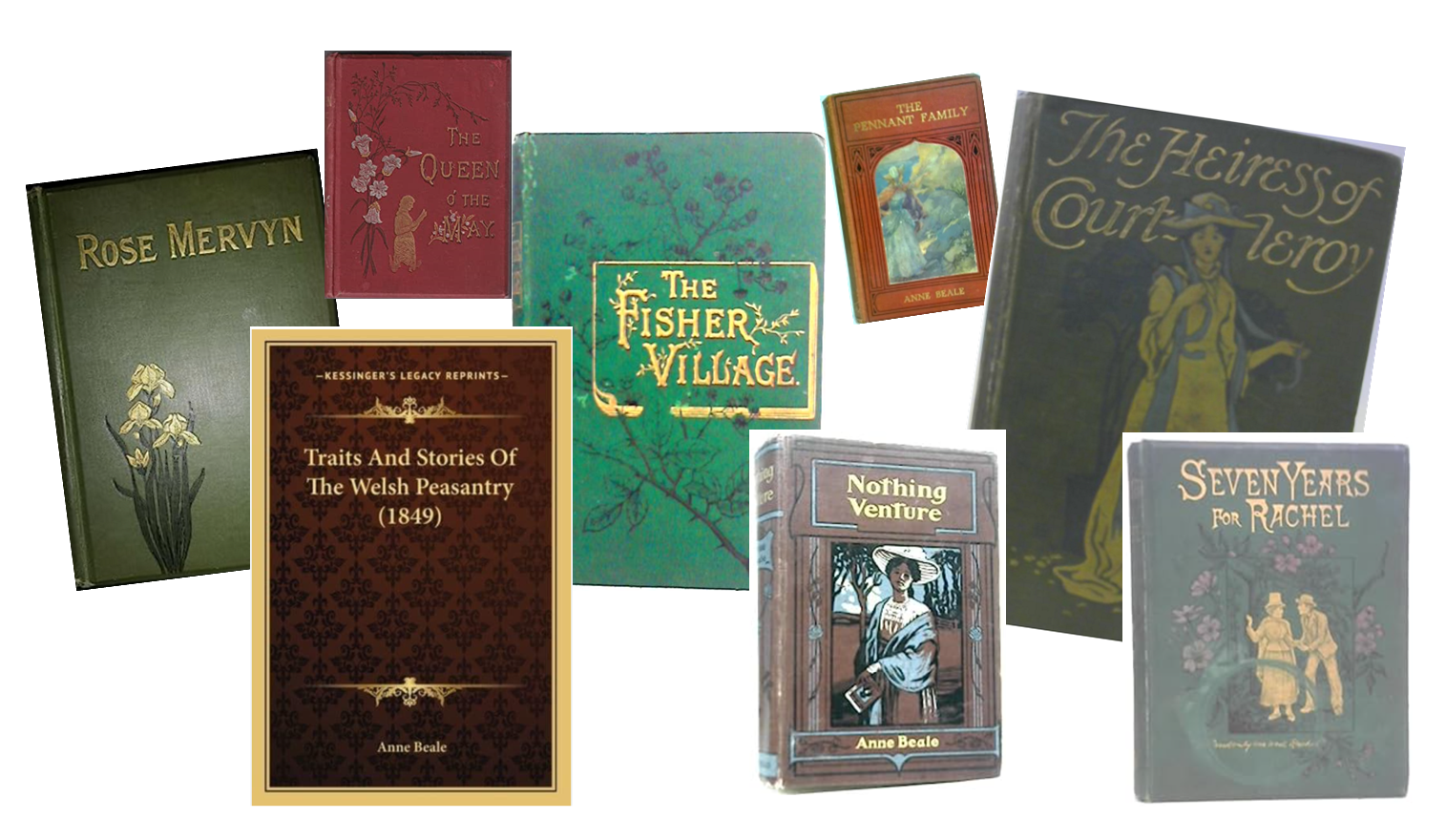
NB: The following list is taken mainly from two websites: the above-mentioned Welsh Costume website (https://welshhat.wordpress.com/introduction/the-nature-of-the-evidence/anne-beale/) and At the Circulating Library: A Database of Victorian Fiction, 1837—1901 (https://www.victorianresearch.org/atcl/show_author.php?aid=19). These and other sources differ in some details such as title and dates. Some were published originally in serial form in various magazines, and/or in more than one volume and some were reissued in different form, even under a different title. These are her novels, plus her 1842 collection of poetry. Other poetry appeared in various different publications (see, for example, Welshman, 26.12.1845). About half of her novels were set in the Wales of the mid-19th century, with which she was familiar.
- Poems. 1842
- The Vale of the Towey. 1844
- Traits and Stories of the Welsh Peasantry, 2nd ed of The Vale of the Towey, 1849
- The Baronet’s Family: A Novel. 3 vol. 1852.
- Simplicity and Fascination: or, Guardians and Wards. 3 vol. 1855.
- Gladys, the Reaper. 3 vol. 1860.
- Nothing Venture, Nothing Have: A Novel. 3 vol. 1864.
- Country Courtships: A Novel. 3 vol. 1869.
- Fay Arlington. 3 vol. 1875.
- The Pennant Family: A Novel. 3 vol. 1876.
- The Miller’s Daughter. 3 vol. 1877.
- Rose Mervyn of Whitelake. 3 vol. 1879.
- Idonea. 3 vol. 1881.
- The Queen o’ the May. 1881.
- The Young Refugee. 1882.
- Squire Lisle’s Bequest. 3 vol. 1883.
- The Fisher Village. 1884.
- Seven Years for Rachel: or, Welsh Pictures Sketched from Life. 1886.
- Courtleroy. 3 vol. 1887.
- Restitution: A Novel. 3 vol. 1889.
- The Farm on the Down, and Old Gwen, 1890
- The Twin Houses and Other Tales of Real Life, 1890
- Charlie is my Darling. 2 vol. 1891.
Click on an image below to enlarge it and see the caption