For several decades in the first half of the 19th century, Vincent Stuckey was a leading light in Langport’s civic and economic life. As his reputation grew he became a respected figure in the West Country, and indeed at a national level.
He was born in Langport on 24 March 1771, the youngest of the eight children of George Stuckey (1731–1807), a prominent local merchant, and his wife, Edith (1742–1793), daughter of Thomas Beedal, of Langport. This was just about the time when the Stuckeys’ commercial businesses were expanding, under Vincent’s uncle Samuel, into banking services. This became the noted Stuckey’s Bank, which Vincent later ran for many successful years.
Young Vincent was an ambitious and outgoing child, best demonstrated when, being around 19 or 20, he went to the nearby Burton Pynsent estate, home of the Pitt/Chatham family (who were friends of the Stuckeys), and asked the formidable Lady Chatham – widow of the former Prime Minister, William Pitt the Elder and mother of the current Prime Minister, William Pitt the Younger – for an introduction to her son in London.
Lady Chatham was impressed enough with young Vincent to provide such a letter, which led to him obtaining a clerkship at the Treasury. He held a number of Treasury posts over the following decade, and was close both to Pitt himself and to a rising minister, William Huskisson. When there was serious rioting in London in July 1795, affecting Pitt’s home, Vincent wrote to Lady Chatham to reassure her that her son was well, a fact she mentioned with gratitude in a letter to her son.
Vincent looked set for a successful career as a senior government official, but he resigned from the Treasury in 1801 (though he seemed to have retained a notional, perhaps sinecure Treasury post for some further years), and returned to Langport to join the family businesses. This was probably due in part to his marriage in Langport on 16 April of that year to his cousin, Julia (daughter of Samuel).
He rose rapidly in the Bank, becoming a partner in 1807 due to the ill-health of his father, George, and his uncle, Samuel, who both ran the thriving private bank, known since 1806 as S&G Stuckey & Co. For a time, the name became S,G & V Stuckey & Co. Vincent thereafter virtually ran the bank, especially after the death of his father in June 1807, and when Samuel died in 1812, Vincent was the senior partner.
Although generally a careful and cautious banker, he had a good eye for any opportunity to boost his (and his bank’s) financial prospects. Early in his tenure, he was on holiday in Devon and just happened to visit a John Stuckey of Branscombe, ostensibly because of his identical surname. John was a local JP and a very wealthy landowner, but elderly and unmarried. Several other visits followed, and when John died in 1810 aged 91, his will bequeathed around half of his extensive estate, including lands around South Petherton, to Vincent.
Under his leadership, Stuckey’s Bank grew through the opening of new offices and branches across Somerset, and the acquisition of other local private banks. In 1826, he took advantage of new legislation to make it one of the very first joint-stock banks, becoming known as Stuckey’s Banking Company, and a few years later a London office was opened.
As the Bank’s reputation grew, Vincent became the influential voice of country banking, and gave evidence to a number of Parliamentary committees on banking matters, where he would happily expound his philosophy, based on his practical experience at Stuckeys. In later life, he was close to Sir Robert Peel, acting as his adviser during long debates on currency reform which culminated in the important Bank Charter Act of 1844.
He also had other business interests, including a directorship in the West of England Fire Insurance Company, and in other Stuckey family enterprises, such as a significant and lucrative salt business out of Droitwich, which generated a large proportion of the country’s salt duties.
As a leading Langport worthy, Vincent Stuckey regularly indulged in philanthropic and charitable activities towards his fellow citizens, and to local ‘good causes’. There were often press reports of such gestures, especially at particular holiday seasons or in response to natural disasters and other times of distress. Such acts were expected of prominent people of his status in local communities at that period, and generally were reported in glowing terms.
For example, just before Christmas 1823, he distributed to the poor of Langport and Huish a “fat bullock and potatoes, apportioning the quantities of each to the circumstances of the respective families”, and the Sherborne Mercury gushed: “How religiously do these noble acts of spontaneous benevolence display the real attributes of a truly philanthropic spirit.” Seven years later, it was reported that he assisted his tenant farmers at Fivehead, who were suffering from flooded fields and high livestock mortality.
He also made donations to local improvements, such as a gift of 20 guineas for a new organ at Langport Parish Church, when it reopened in early 1826 after major renovations, and an “elegant and massive service of communion plate” to the Church in 1839.
The standard work on Stuckey’s Bank, published in 1928, described him as “the lord bountiful to the poor and needy of the town and surrounding country and his generous and hospitable nature made him beloved by rich and poor alike.”
He held a wide range of local offices, from being Portreeve (mayor) of Langport 3 times (1810, 1823 and 1833), to being High Sheriff of Somerset in 1822. His various civic offices gave him some local quasi-judicial duties, though we have no detailed record of his treatment of those who came before him. Penalties were extremely harsh in those days, including transportation or even death for relatively minor offences. When he himself was the victim of a break-in at his Langport home, Hill House, in July 1827, when plate worth £100-£200 was stolen, the apparent culprit, a previous offender called Kerslake, who had just returned from 7 years’ transportation, was found guilty at Bridgwater Assizes and sentenced to death by Chief Justice Best. Kerslake was executed in front of Ilchester Jail before a reported crowd of 10,000 spectators.
As Sheriff of Somerset, he presided at public meetings, especially a major event on parliamentary reform at Wells in 1823, in which the famous activist, Henry ‘Orator’ Hunt, participated. Reform was a long-running and highly controversial in the early 19th century, and Vincent’s public roles made his own position difficult. He was even reported in the press as planning to stand in the 1831 general election for the Somerset county constituency, but that never materialised.
Vincent had a London house in Sloane Street, but his main residence was a fine property, Hill House, on Langport Hill opposite the parish church. It was probably built around 1817, as a press report of October of that year refers to an evening entertainment on 23 September at his “new built mansion in Langport.” He jealously guarded the land around Hill House. In 1829 he prevented the building of an Independents Chapel off nearby Priest Lane, providing land in the town centre as an alternative site. He built stables at Hill House in 1836, requiring the alteration of Priest Lane, and also stopped-up a path from Priest Lane to Bond’s Pool because it went too close to his house. He had a scare in February 1845 when a serious fire at the Church threatened Hill House, but fortunately, it was safely put out.
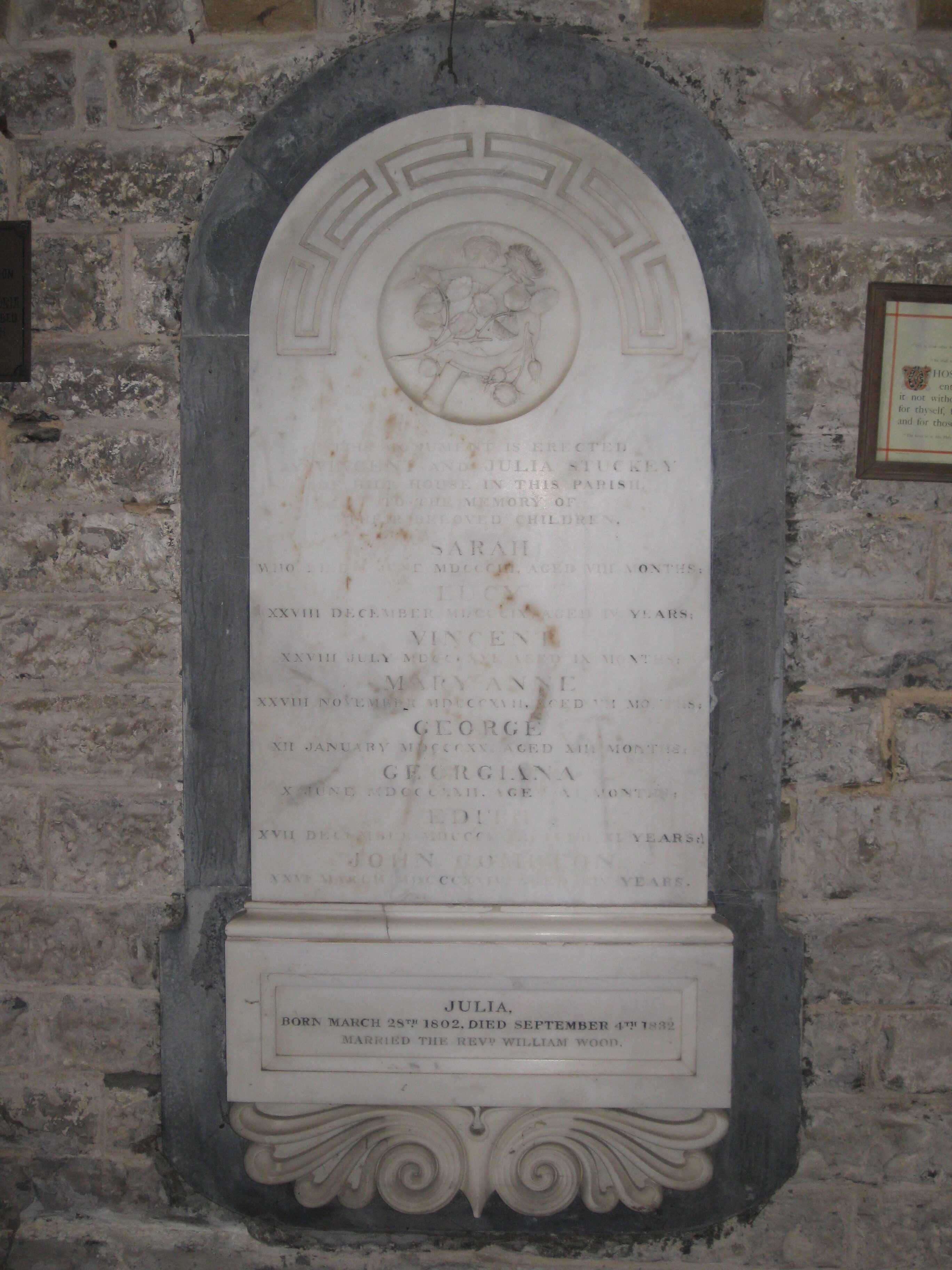
One tragic aspect of his domestic life was the very early deaths of many of his 10 children, as recorded in a memorial plaque in the Church. Perhaps this had a hereditary cause, deriving from the marriage of first cousins. It meant that Vincent had no surviving son to succeed him, although he was rumoured to have had an illegitimate son, whom he looked after financially.
Vincent died on 8 May 1845 at home – in his library, according to some reports – and was buried in the Parish Church of All Saints, Langport on 16 May. It was intended to be a private occasion, but many locals got permission to attend to pay respects. In 1863 a memorial window to Vincent and his wife, Julia, who had died in 1861, was installed at the north transept of the Church, donated by his namesake, and successor as head of the Bank, Vincent Stuckey. Following extensive renovations in 1877, the window was moved to the south chapel, where there is also a large memorial tablet detailing the families of his father and uncle, George and Samuel Stuckey.
Click on an image below to enlarge it and see the caption
You can read more about Stuckey’s Bank in the pages about Cheapside.