His death
Walter had always suffered from poor health, and on Sunday 18 March 1877, while he was working in the study of his London home at 8 Queen’s Gate Place, he caught a new cold which took hold. Though the cold winds were coming through the barely-protected windows – they were awaiting the delivery of new curtains ordered from the firm of William Morris – Walter had refused to take steps to keep warm and would lie full-length on a sofa under the windows, rather than by the fire. His wife, Eliza called in his doctor.
His sister-in-law, Emilie Barrington, his later biographer, wrote that “during his last days he appears to have thought seriously of his state of health” and reported a friend of his as recalling that, at that time, Walter had told a member of The Economist staff “that he did not think he should get over his cold.” She also wrote that, during his final week in London, “he left his bed and, going up to his study, made his will.” (On this last point see the discussion below.)
Walter refused to stay in bed because he had promised his father he would spend Easter at Herd’s Hill, his father’s home just outside Langport. Emilie recalled their departure from their house: “When he started he was clearly ill. My sister and I were in the carriage and my husband was on the pavement to see us off. Before Walter got into the carriage, he turned to him to say goodbye. But there was no accustomed quaint word of fun, no life. The lamp was already burning low. For the first time the boyish spirit seemed extinguished.”
He and Eliza left from Waterloo Station on the afternoon of Tuesday 20 March, the original plan to depart that morning being changed as Walter had agreed to attend The Atheneum to vote for a friend of Eliza’s as a member. It was a raw, wintry day, and matters were not helped by a long delay between trains at Yeovil Station.
Walter was very ill when he arrived at Herd’s Hill. He was attended by doctors, and, though managing to play cribbage with his aunt – Emma Michell (his father’s youngest sister) -who was nursing him, he was diagnosed on 23 March as having congestion of the lung.
We have a detailed account of Walter’s final day, Saturday 24 March, in Eliza’s diary entry – the longest of any entry in her diaries – in a sheet of paper inserted into the 24 March page. According to a study of Eliza and her family, based on her diaries, it seemed that, despite his obvious serious condition, Walter’s final deterioration was something of a shock: ”Still there is a note of clammy incredulity as Eliza writes of his death – so terrible in its suddenness.” [M Westwater, The Wilson Sisters, 1984, p87]
Walter slightly better after 5am. I breakfasted with him and his aunt left the sofa and went to bed. I spent morning on the bed by him and cut a new copy of Rob Roy for him to read. Mr Brooks came at 9 and 2 and was satisfied that his bronchitis was rather better. Walter spoke often of his extreme weakness increasing as the day advanced. I spent afternoon behind curtain so as not to disturb him and wrote to Mr Batten and Mr Wm Coles for him. About 4 he asked me if I “had been down to the parlour today”; he exerted himself with his pillows and would not let me help him, saying, “let me have my own fidgets”, but called me to him and soon fell fast asleep across the bed – breathing very loud and hard. This gradually quieted and I went down and told his father and aunt the change for the better had come – then knelt by him to count his pulse at 5:25 but had my own; – while I counted, a little purple came on his lips and he became still and white. I called his aunt – then poured brandy down his throat. They said it was of no use and I knew he was gone.
He was just 51 years old. His post mortem concluded that he died of ossification of the lung. According to Emilie, there had been rumours of Walter’s death in that Sunday’s papers, which her servants had seen but didn’t report them to her, as they may have thought they referred to Walter’s father, not Walter himself. Emilie only discovered the truth on the Monday morning through letters, telegrams and press reports, and on Wednesday 28th, she and her husband, Russell, and her sister, Julia Greg, travelled to Langport for the funeral.
His funeral
Walter’s funeral took place on 29 March 1877 (Maundy Thursday). The main sources for the events are the diary entry by Walter’s widow, Eliza, and the reports in the Langport Herald of Saturday 31 March and 7 April. According to Eliza’s diary entry for 26 March, Edward Bagehot, Walter’s uncle, consulted with her about the funeral arrangements. That same entry stated that Walter’s father, Thomas Watson Bagehot, also amended his will, replacing Walter with Eliza. Interestingly, there seems to be no reference in the diary or press report of Thomas attending his son’s funeral, though other family members are listed, which may suggest that he was unable to be there.
The cortege of the hearse and four mourning coaches left Herd’s Hill just after midday – Eliza’s diary has it as 12 noon, while the Herald states it was 1pm – and travelled to St Mary’s Church, Huish Episcopi. Emilie wrote that a photograph existed – sadly no longer – of “the simple procession as it passed through the street of the little ancient Langport town, the gig of the undertaker leading the way, which was the local fashion in those days.”
Huish Church was the venue, as the usual family church, All Saints’, on Langport Hill was then under restoration. The service was performed by the Huish vicar, Rev Edward Henslowe. The funeral party then proceeded up The Hill to All Saints’ churchyard, where the coffin was interred in the family vault in the south-eastern corner, after Eliza’s sisters laid a cross and wreaths of white flowers on it. Rev Henslowe again presided, and various family servants acted as bearers and pall-bearers.
According to the Langport Herald, “The inhabitants [of Langport] generally testified their respect towards the deceased gentleman by closing their shops during the afternoon.”
Three days later, on the afternoon of Easter Sunday, before a large congregation, Rev Henslowe gave a funeral sermon at Huish Church, based on Matthew xxiv, 44. “Be ye also ready, for in such an hour as ye think not. The Son of Man cometh.” He also referred to the “immeasurable loss” of Walter’s death, saying that it required abler hands than his to do justice to the great talents of the deceased. All deeply sympathised with “his aged father in his bitter grief at the loss of such a promising son.” It was noted in both Eliza’s diary and the Herald report that the service was attended by members of Langport Corporation, in their official robes and preceded by the sergeant-at-mace, with the symbol of office draped in black. Walter had been the Corporation’s Deputy Recorder. The Corporation formally recorded a fine tribute in the minutes of its 26 May meeting.

His will
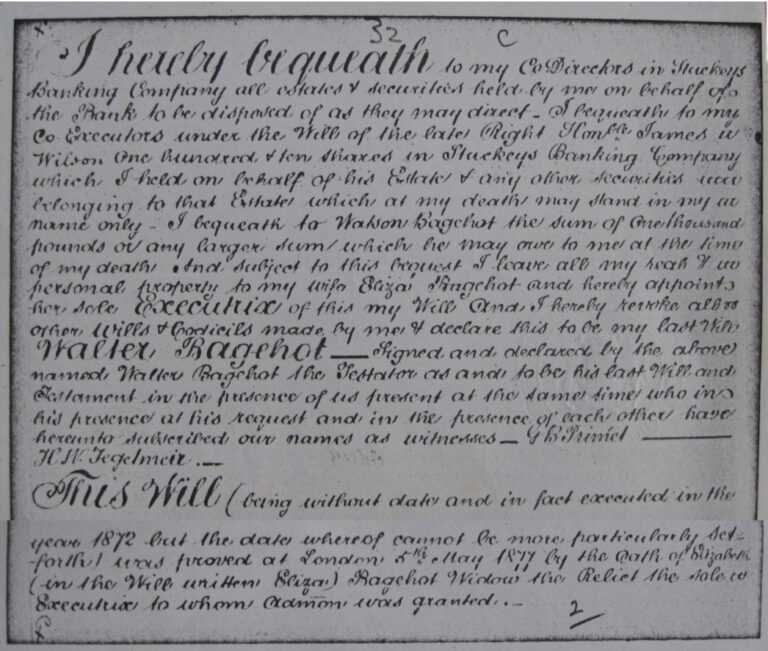
Walter wrote a will which, though it was undated, was stated on the existing ‘office copy’ as having been executed in 1872. Whether this is the same will that Emilie Barrington claimed he wrote in his final days in London in 1877 is not known. It was proved in London on 5 May 1877 by the oath of Eliza as widow, relict and sole executrix to whom administration was granted. Her oath may actually have been given earlier, as her diary entry for 25 April noted that, while at Herds Hill, “Mr Estlin brought Mr Parsons to swear me to affidavit for probate duty at 11 o’clock.” The Langport Herald of 9 June reported that the personal estate was sworn as under £40,000.
He left to his co-directors in Stuckey’s Banking Co all estates and securities held by him on the Bank’s behalf; to his co-executors of the estate of his father-in-law, James Wilson, 110 Bank shares, and any other securities, held by him on the estate’s behalf; and to Watson Bagehot – a distant cousin brought up by Walter’s parents following his mother’s early death – £1000. All the rest of Walter‘s estate was left to Eliza.