

Meeting, courtship and engagement
Walter first met Elizabeth (Eliza) Wilson on Saturday 24 January 1857 at Claverton Manor, just outside Bath (now the site of the American Museum), which was rented by her father, James Wilson, a prominent Liberal MP and founder of The Economist. Young Walter was keen to write for the magazine and had arranged a meeting with him. Eliza, then aged 24, was the eldest of 6 sisters, and Walter took her down to dinner that evening. The remaining sisters saw him for the first time at breakfast the following morning, but Eliza was absent due to a headache. They all seemed to take to him immediately, especially Eliza, and the feeling was mutual. He became like the brother they never had.
Walter and Eliza’s courtship proceeded during the following months, at Claverton (where Walter stayed at Easter) and at the Wilsons’ London residence, 15 Hertford Street, Mayfair. ‘Mr Bagehot’ increasingly populated Eliza’s diary entries, and the relationship grew more serious in the autumn. On 27 September, Walter felt able to tell Eliza of his mother’s mental illness, but, fortunately, that did not put Eliza off.
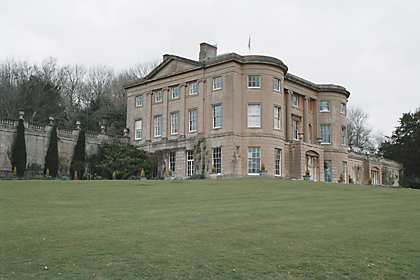
Bagehot had talks with Eliza’s parents at Claverton in early November, which led to a ‘chance’ meeting in the library – Eliza’s diary states that “then he got me in here alone under pretence of looking for a book” – where he proposed to her on Wednesday the 4th. It was agreed that she should give her answer when they were back in London. This she did on the morning of Saturday, 7th as her diary records: “Mr. Bagehot came at I0 for my answer. I was in the dining room, and engaged myself to him then and there….”
At this crucial point, the couple had to part ways for a time. Walter had to return to business in Langport and in London, as there was a national financial crisis taking place. Eliza and her younger sister Sophie accompanied their father to Edinburgh, where he had government business. While there, she was due to consult a noted doctor, John Beveridge, who did head massages to cure headaches.
Walter and Eliza began an intense series of love-letters, which her sister Emilie published in 1933. Walter missed Eliza badly, and was scathing about “the rubbing doctor”, and was convinced he was a charlatan who aimed to keep her in Edinburgh as long as possible. In a letter from Herd’s Hill on 22 November he wrote: “What is the particular advantage of being rubbed at Edinburgh? Since yesterday I have made careful enquiries and am assured that the English can rub. Why not be rubbed in Somersetshire? Let the doctor mark the place and have a patch put to show where to let an able-bodied party in the West of England rub on the same place and surely it will be as well?”
He determined to visit her in the Scottish capital and arrived there on Sunday 13 December. On Wednesday 16 December (Eliza’s 25th birthday), the couple exchanged engagement rings and, for her birthday, Walter gave her several small volumes of poetry by Wordsworth, Keats & Shelley, bound in red calf.
Wedding, honeymoon and new home
Walter and Eliza’s wedding took place on Wednesday 21 April 1858 at Claverton, which the Wilsons had rented since 1855. The bridal party left the Manor at around 11am, and the marriage ceremony at the local church was performed by Rev William Hale, Rector of Claverton. Eliza wore, according to press reports, a dress of white velvet, with a Honiton lace veil, and a wreath of roses and orange flowers.
Neither of Walter’s parents attended – his mother was not well enough for such an event, and his father stayed behind to be with her. However a cousin, Mary Watson Bagehot, was a flower girl, and Vincent Wood (grandson of the first Vincent Stuckey, and head of Stuckey’s Bank for many years) was Walter’s best man.
Eliza’s diary entry summed up the day rather crisply:
“Our wedding day. Beautiful and hot. Church quite full. Used our pew for vestry. Walked on lawn after church. Hanoverian band played. At breakfast Mr Moffatt proposed our health. Sir William Topham proposed the bridesmaids in a very clever speech. Over at 2:30. Walter and I started in post chariot at 3:30. Numbers of Bath people had arrived for the dance. I went into morning room to see them. Six white satin slippers thrown after us. We drove to Frome, changed horses, and took up luggage, and got to Stourton at 7.”
A letter from Walter to his mother two days into the honeymoon provided more details. He had already sent her a brief note in pencil from their Frome stop, which simply informed her that “We are married. Everything went off well, and my wife sends her love.” Dated 23 April, from Stourton on the Somerset/Wiltshire border – ie Stourhead, where they had the previous day walked to King Alfred’s Tower – he wrote:
“I am scarcely an impartial judge, but it seemed to me a very bright affair and that not only the persons married but the others enjoyed themselves, which generally they do not. Nobody shed a single tear. Eliza was a most composed bride – a little anxious at the crisis, but very cheerful after it was over. Vincent Wood made a splendid ‘best man’ only that the multitude would think he was the bridegroom. Mary was much admired and all the bridesmaids were very animated and nice. There was wonderful oration at the Breakfast. A Mr Moffatt (MP for Ashburton) proposed our health in a copious and eloquent manner, and spoke of the ‘hundreds of thousands’ who had read my writings, whom I myself should wish to see particularly. Sir William Topham proposed the health of the bridesmaids in a very clever speech in a sort of Lord Palmerston style. He is a man about the Court, Captain of the Yeomen of the Guard and understands the ‘touch and go’ style of oratory rather well. My attention was rather, however, distracted from what he said by wondering that ‘that man’ should be speaking at my wedding. Few people seem so far off my beat. I believe that the dance too after we went away was also successful, and the day was so gorgeous that I think it made people cheerful. Mind will tell especially in the weather. We had a delicious drive to this place and have done nothing but potter about it ever since. Eliza is a trifle tired by the crisis, but very well and seems able to endure futurity. The post is going so I must leave off. With best love to my father.”
In a touching addition at the end of the letter, Eliza added a postscript: “I am your affectionate daughter, Eliza Bagehot. This is the first time I have signed my new name.”
Press reports gave a little more detail of the festivities, especially after the happy couple left at 3:30. What was described as a “continuous stream of company” of at least 200 guests from London and the local community began arriving from 3pm, being received by the bride’s parents for a fete champêtre, ie a garden party. Dancing began at 3, and continued until 9pm, in good weather, on the lawn and in the ballroom. Many of the company wandered round Claverton’s extensive grounds or were “enjoying the hospitality of the kind host and hostess.”
After a brief stay at Stourton, Walter and Eliza spent the rest of their honeymoon touring Devon by coach and by train, visiting places such as Dawlish, Plymouth, Bideford, Ilfracombe and Teignmouth. Walter wrote several brief notes to his father, and the couple read a great deal of Matthew Arnold’s poetry, theologian Frederick Denison Maurice’s sermons and John Henry Newman’s Lyra Apostolica (a collection of sacred poems). At the end of May, they travelled through West Somerset, catching a train at Bridgwater for Clevedon. There they settled in to their new home on the hills around the town, The Arches (renamed by them from its original Bella Vista) which they had rented from Sir Arthur Elton of Clevedon Court. Clevedon was a convenient location both for Walter’s travels to Bristol on bank business and to Langport, and for visits to Claverton.
A week after their arrival at Clevedon the protracted wedding events concluded with the couple meeting their respective new families and friends, beginning with a trip to Herd’s Hill for sitting up, a West Country tradition where a new bride received guests, followed by a family gathering at The Arches, then a stay in London before finally returning to Clevedon.